
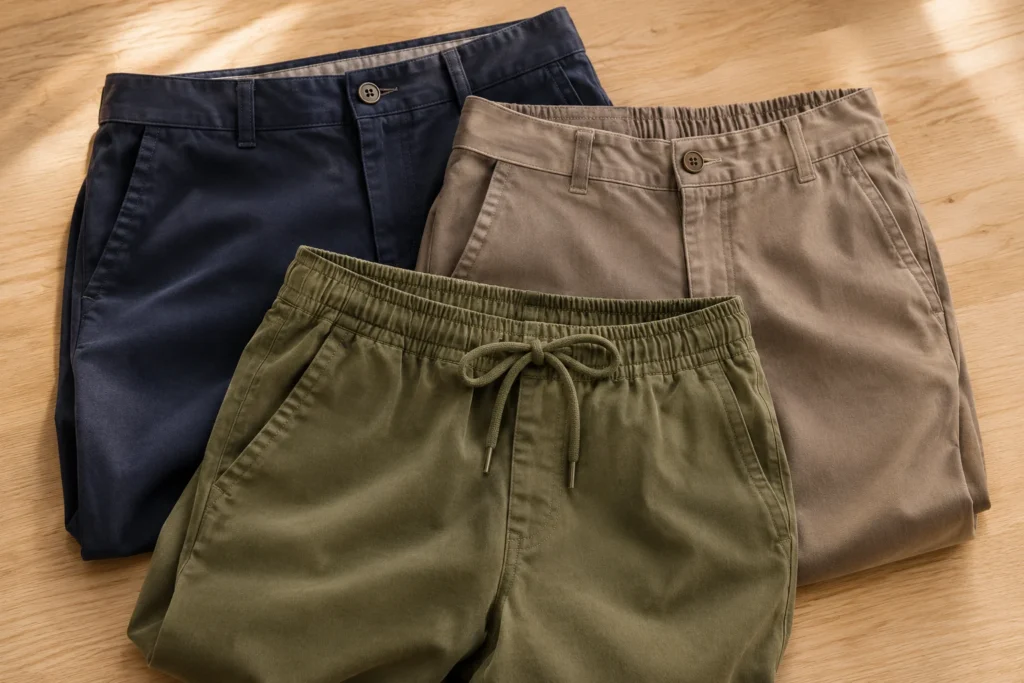
A waistband can fit when you stand in front of a mirror and still be awkward when you sit, reach into a pocket or adjust a tucked shirt. The useful question is how that particular waistband holds the trousers at the position you want to wear them.
Fixed, elasticated and drawstring are overlapping descriptions. A trouser can have a fixed-looking front, elastic at the back and a drawcord inside. Read the construction details before treating the style name as a complete explanation. For a larger waist, keep the required inside leg separate: more stretch at the top does not provide a shorter or longer leg.
Separate fastening from adjustment
A button, hook or zip opens the trousers. Elastic changes the circumference as it stretches and relaxes. A drawstring lets you secure an opening at a chosen point. A belt is another adjustment, provided the garment has suitable loops. These features do different jobs, and one does not automatically replace another.
| Construction | Useful question | What it cannot establish |
|---|---|---|
| Fixed waistband | Does the labelled waist work at my chosen wearing position? | Seat room, rise or thigh room. |
| Part-elastic waistband | Where is the elastic, and is a relaxed or stretched measurement supplied? | That the whole waistband stretches equally. |
| Fully elasticated waist | Can I put the trousers on and sit without the band rolling or digging in? | A universal extra allowance in inches. |
| Drawstring waist | Is the cord internal or external, and can I tie and release it easily? | That a much larger size will stay comfortable when tightly gathered. |
UNIQLO’s Wide Parachute Trousers description, for example, identifies both an elasticated waist and a drawstring. It separately describes the high rise. That is a useful reminder that waistband adjustment and the position of the waistband are distinct product details.
Start with the position you actually use
Measure according to the chosen retailer’s instructions. BadRhino’s trouser guidance uses the belt position; another chart may use a different point. Do not compare two readings taken at different heights as if they describe the same waist.
With trousers you already like, note where the front and back sit, whether you wear a belt and what happens when you sit down. If you prefer a higher or lower position in the new pair, the same labelled waist may not answer that preference. Our larger-waist, shorter-leg guide explains why rise and inside leg deserve separate attention.
Compare the details on actual trousers
Use the waistband description alongside the exact waist-and-leg option. Open the retailer’s page for the fastening, material and care information, especially when a photograph hides an internal cord or elastic panel.
Try a short movement sequence
- Fasten normally. Do not begin by pulling the cord as tight as possible or adding a belt to compensate for a plainly unsuitable waist.
- Sit on an ordinary chair. Notice pressure at the front, whether the back drops and whether the top of the band folds. Check with the shirt you intend to wear.
- Stand and walk. See whether you repeatedly need to lift the trousers or retie them.
- Use the pockets. Try normal light contents. A waistband that works with empty pockets may feel different with your usual phone and keys.
- Undo the fastening. Check that buttons, hooks and cords are manageable for you. An easy closure is a useful feature in its own right.
Assess these points while keeping the garment in a condition acceptable under the retailer’s returns policy. If the seat pulls or the crotch feels restrictive, extra elastic at the waist may leave that problem unchanged. Compare another cut rather than relying on a tighter cord or the assumption that the fabric will give later.
Make a useful comparison note
Write the labelled waist and inside leg, where the band sits, which sections stretch and whether the cord is inside. Add one sentence about sitting and one about walking. This gives you a better reference for your next order than simply recording that a pair was “too small”.
Browse trousers and chinos when you are ready to compare constructions. For the measurement methods behind the labels, use our men’s measurement guide.
Sources and how we checked
Researched by Plus Size Me Men. Official sources checked on 5 November 2026. We compared published garment details, measuring instructions and care guidance; we have not worn or washed these examples. Product details can change, so check the selected item before ordering.


